

Musajil: Event Day Is an Operations Problem
Musajil is an enterprise event management platform: guest-first registration, offline-tolerant QR check-in, a real-time ops command center, and predictive analytics.
By Khalil Abu Mushref ·
The lanyards are alphabetized, the welcome screen is looping, and the first guest of the night is standing at the registration desk watching a check-in tablet that has stopped responding.
In that instant, the event stops being a plan and becomes an operations problem. A registration desk with a queue forming and a venue network that just died. A sponsor asking how many VIPs have arrived. An ops lead trying to run the room off a spreadsheet and a group chat.
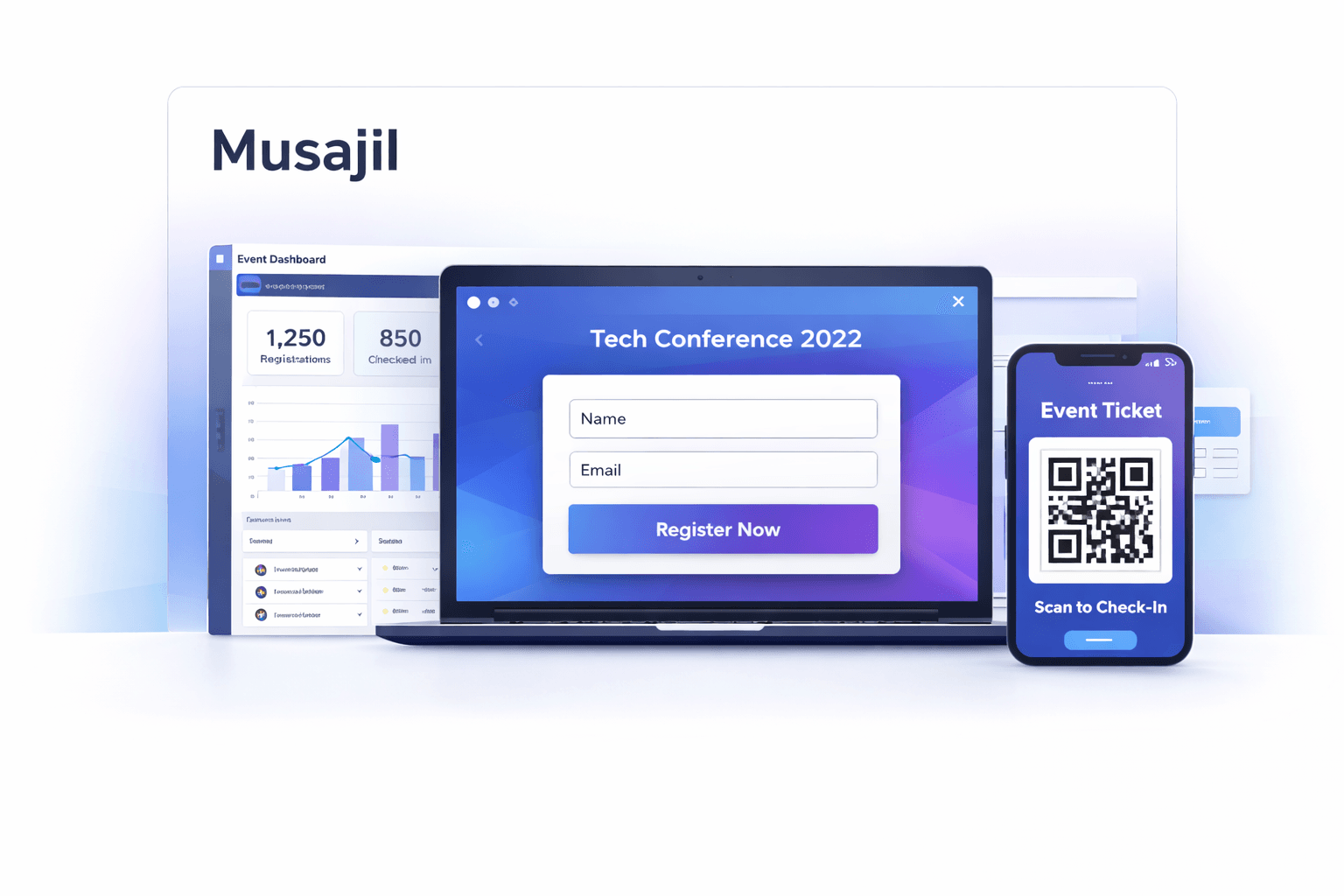
Musajil was built for that moment. It is an enterprise-grade event management platform designed around four ideas — guest-first registration, a real-time operations command center, offline-tolerant check-in, and predictive analytics — so the event runs like a system, not a scramble.
The Reality of Event Day
Most event software is built for the weeks before the event: forms, invitations, confirmations. All useful. None of it is where events actually fail.
Events fail at the door.
They fail when the check-in tablet loses Wi-Fi and the queue backs up into the lobby. They fail when nobody can answer the simplest operational question — how many people are actually inside right now? — without radioing three volunteers. They fail when the first sign of trouble is a crowd, not a number.
Event day is a live operation, and live operations need live systems.
Everything in Musajil is downstream of taking that literally.
Inside Musajil
Registration that starts with the guest
Registration in Musajil is guest-first: the experience is designed around the person registering, not around the organizer's back office. The guest's path — register, get confirmed, show up, get in — is the spine of the platform, and everything operational hangs off it.
A command center, not a report
The real-time operations command center is the organizer's view of the live event. Not a recap the morning after — a live picture while the event is happening, shared by everyone running it.
This is the same conviction I carried out of enterprise BI reporting: decisions get better when the numbers are live, shared, and trusted. On event day, that principle stops being a dashboard philosophy and becomes the difference between managing a room and guessing at it.
Check-in that tolerates a dead network
Venue networks fail. Not occasionally — reliably, and always at the worst moment.
So Musajil treats connectivity as a risk, not an assumption. Check-in runs on QR codes and is offline-tolerant — built to keep the desk moving when the connection doesn't cooperate, because the queue at the door does not pause for IT.
Predictive, not reactive
The last piece is predictive analytics — pointing the platform at what is building, not just what has happened, in service of one goal: a seamless event. The best ops teams I have worked with act on signals, not crowds. Musajil's job is to hand them the signal early.
What Enterprise Event Ops Taught Me
Musajil condensed a few lessons enterprise delivery work has taught me more than once:
- The network is a risk item, not an assumption. Any system that only works online is a system that fails on stage.
- The guest does not care about your back office. They experience the registration flow and the door. Optimize those first.
- One shared live picture beats ten accurate private ones. A command center is as much an alignment tool as a monitoring tool.
- Prevention looks like nothing happened. The predictive angle is thankless — when it works, event day is simply... calm.
None of these are event-specific. They are operations truths, and events are just operations with an audience. That is the thread running through my projects: find the moment where things break, then build the system that refuses to break there.
Musajil is live at musajil.khalil-am.com.
FAQ
Where do most event platforms fall short?
In the gap between pre-event software and event day itself. Most tools handle the weeks before — forms, invitations, confirmations — and stop where events fail: at the door. Musajil is built for the hours when the doors are open, keeping the queue moving through network failures and giving the team one live picture of the room. You can see it running at musajil.khalil-am.com.
What does offline-tolerant check-in mean in Musajil?
It means Musajil treats venue connectivity as a risk rather than an assumption: QR check-in at the door is built to keep the desk moving even when the network does not cooperate.
What is the Musajil operations command center?
It is the live, shared view of the event for the team running it — a real-time picture of operations while the event is happening, instead of a recap the morning after.
Who is Musajil for?
Musajil is for enterprise event teams who treat event day as a live operation — organizers who need guest-first registration, a shared real-time picture, and a door that keeps moving. Get in touch if you'd like your next event day to be the calm kind.