
Consultant OS: How I Automated My Own Consulting Job
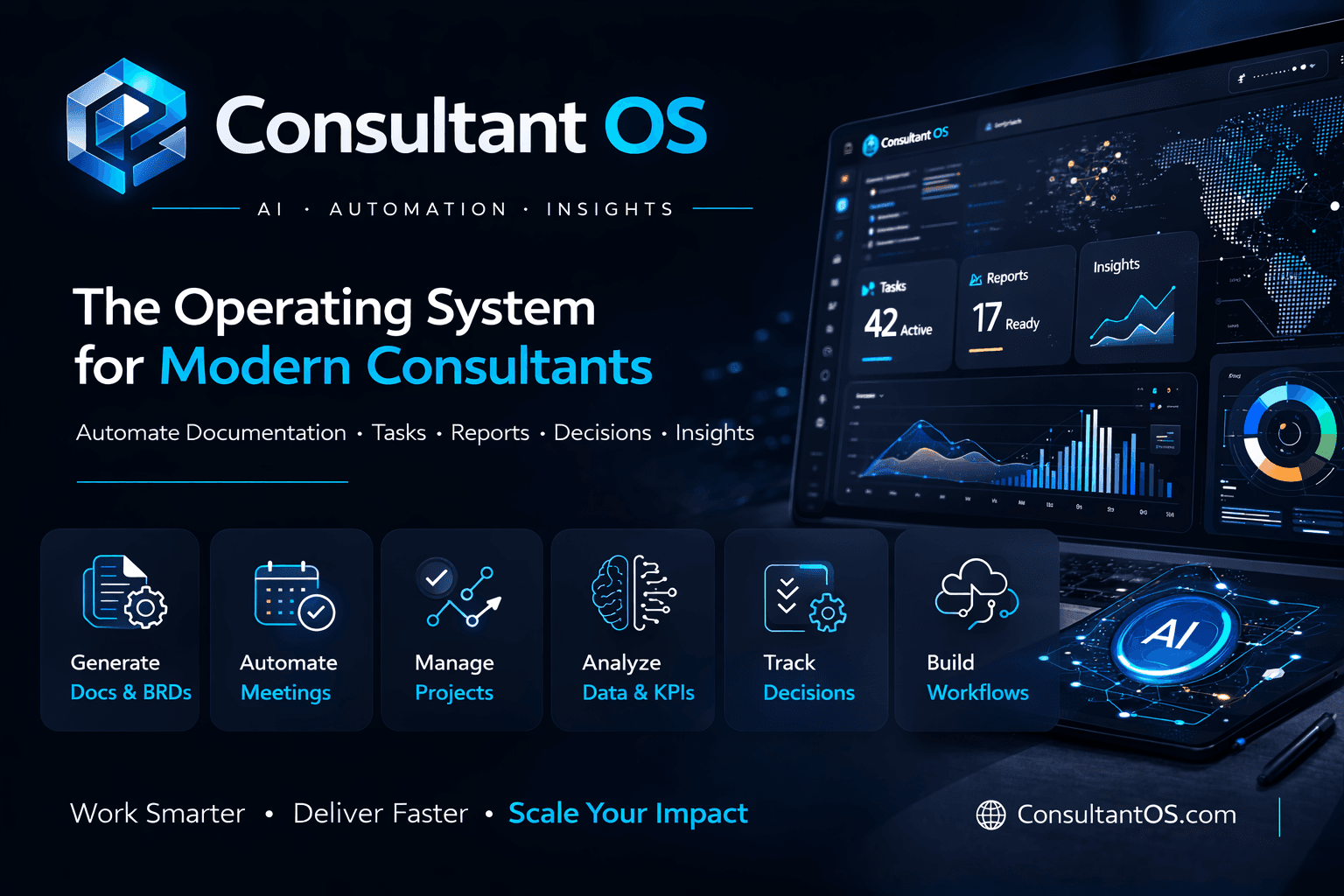
Consultant OS is my AI-powered consulting workspace — automating documentation, meetings, reports, decisions, and workflows for delivery and BA teams.
By Khalil Abu Mushref · ·
On one engagement I actually counted the hours a single week of admin had swallowed: minutes nobody wanted to write, follow-up emails that slipped, status reports eating Friday afternoons, BRDs needing translation and restructuring before anyone could build against them. That invisible payroll gets billed on every project I run.
I spent years standardizing that work. This year I did the more honest thing — I automated it.
Consultant OS is my AI-powered consulting workspace: workspaces, documents, meetings, tasks, reports, and automations in one platform, with AI operating inside every surface. It automates the documentation, meetings, reports, decisions, and workflows that make up the day-to-day of delivery and business analysis teams — and it is live at consultantos.khalil-am.com.
If a process is standardized enough to teach, it is standardized enough to automate.
From Framework to Software
Earlier this year I wrote about the Business Consultant Framework I built at Master Team — structured discovery, agile solution design, governance-ready deliverables, continuous improvement. Then came BC Automations, a library of AI-powered templates that compressed individual deliverables from weeks into hours.
Both worked. Both shared one limitation: they lived next to the work, not inside it. The framework was a methodology you had to remember to apply. The automations were tools you had to remember to run. The actual day still happened in scattered documents, calendars, and chats.
Consultant OS is my attempt to run the engagement itself inside software. It is not a template library — it is the workspace itself. Engagements live in workspaces. Documents, meetings, tasks, and reports hang off the same portfolio. And the AI is not a chat window bolted on the side; it is wired into every module.
What Consultant OS Automates
Meetings. Schedule and track a meeting, and when it completes, the workspace handles the minutes and the follow-up instead of leaving them to good intentions. The most-skipped deliverables in consulting become the cheapest ones.
Documentation. All workspace documents live in one place, searchable alongside workspaces and tasks, and the AI works on the documentation itself — including material that originates in Diwan – CEO Office Management System — instead of leaving it as manual rework.
Reports and attention. Reporting is automated, and the dashboard opens with what actually needs your attention instead of making you assemble that picture manually every morning.
Decisions. Ask AI is an assistant embedded directly in the workspace, and it answers against your live portfolio data, not general knowledge — the questions a consultant actually carries around, spanning strategy, architecture, risk, analytics, and organizational change.
Workflows. Automations get the same standing as documents and tasks — searchable, configured, webhook-driven — with a builder for assembling new ones. A workflow you would previously re-explain to a colleague becomes something you configure once and run forever.
What Still Needs the Human Consultant
Automating my own job taught me precisely which parts of it were never the job.
The machine drafts the minutes; deciding what was actually agreed — and what to do when two stakeholders remember it differently — is still mine. The dashboard flags the critical risk; choosing which risk is worth spending political capital to escalate is still mine. Ask AI summarizes the portfolio; standing in front of a steering committee and defending a recommendation is still mine.
That is the honest shape of AI in consulting right now. The framework told consultants what good looks like. The software now produces most of it on demand. What remains — judgment, trust, negotiation, accountability — turns out to be the part clients were paying for all along.
I did not automate myself out of a job. I automated myself out of the parts that were quietly pretending to be the job.
Key Takeaways
- One platform now holds the engagement end to end — workspaces, documents, meetings, tasks, reports, and automations — with AI wired into each surface rather than bolted on beside it.
- It is the third step of one arc: standardize delivery in a framework, automate deliverables as templates, then move the AI inside the workspace where the work actually happens.
- The routine deliverables come out automatically: minutes and follow-ups from completed meetings, documentation and reporting produced inside the workspace, and an embedded assistant that answers from live portfolio data.
- Judgment, stakeholder trust, and accountability do not automate — and they were always the real product.
- Consultant OS is one entry in a longer projects list — and since the workspace is live, the fastest way to judge it is a walkthrough: get in touch.