
NuRad: Teaching AI to Read Radiology Reports
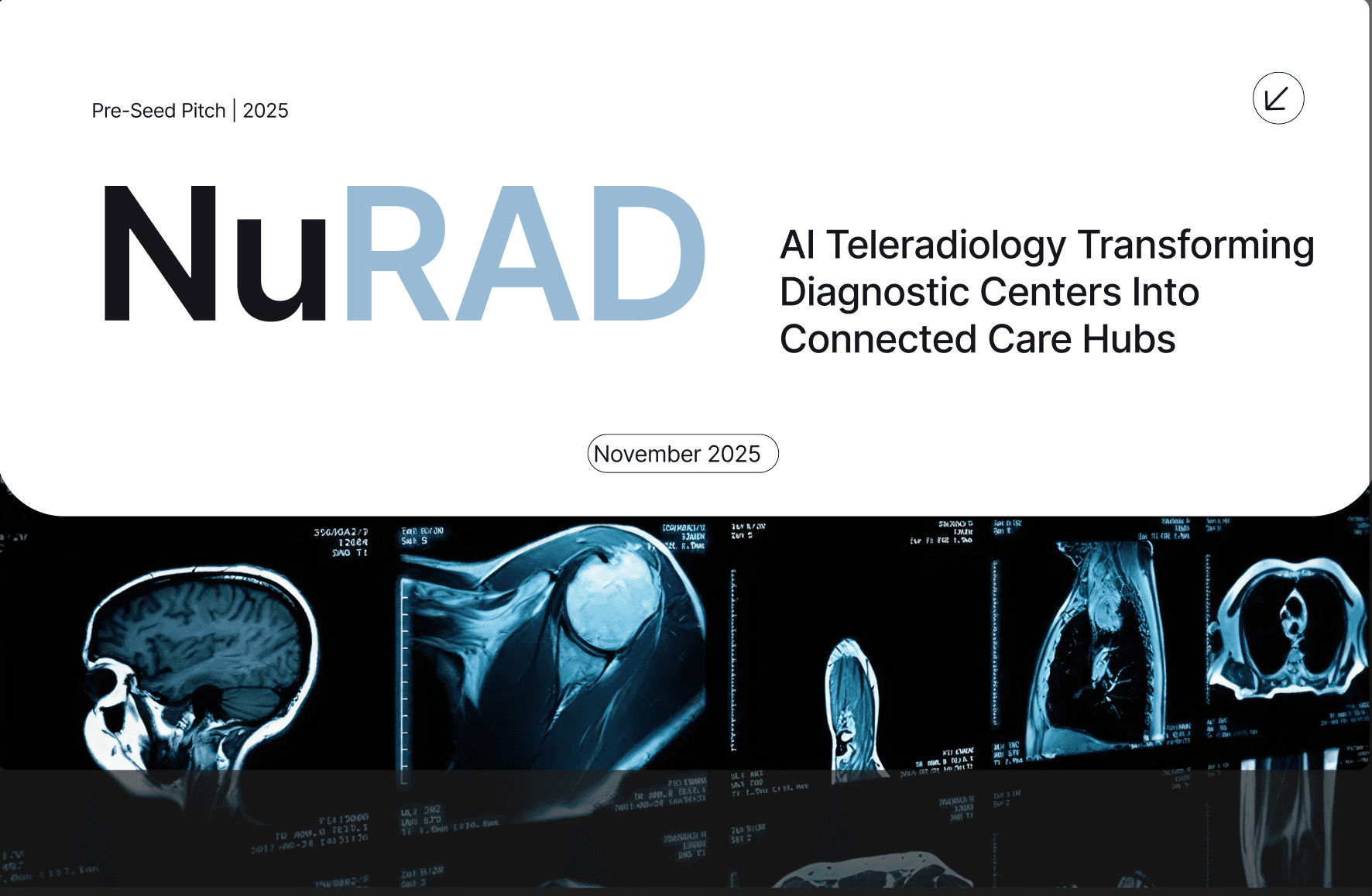
NuRad is a research and portfolio prototype exploring AI-assisted terminology extraction from radiology reports and other unstructured healthcare text.
By Khalil Abu Mushref · ·
Ask a clinician which documents carry the most weight per sentence, and radiology reports will be near the top of the list. Ask a software engineer to parse one, and they will quickly find out why.
That mismatch pushed me to build NuRad—a research and portfolio prototype focused on radiology and clinical terminology scanning. It explores how software might help structure terms and context from medical reports, radiology findings, and other unstructured healthcare text.
NuRad is not presented as a medical device, a clinically validated system, or a tool for patient care. It must not be used for diagnosis, treatment, or emergency decisions. Any future clinical use would require appropriate governance, privacy safeguards, validation, regulatory review, and qualified professional oversight.
Before getting into what NuRad does, it is worth explaining why this problem is genuinely hard.
Why Clinical Text Breaks Ordinary Software
A radiology report is not a form. It is a narrative — dictated under time pressure, dense with abbreviations, and written for another expert, not for a machine.
Three things make it brutal for conventional software:
Negation is everywhere. A report that mentions "hemorrhage" is very often saying no evidence of hemorrhage. Keyword search reads that as a hit. A clinician reads it as reassurance. Any system that cannot tell the difference is worse than useless — it is actively misleading.
In clinical text, the most important word in a sentence is often "no."
The same finding wears many names. One radiologist's "opacity" is another's "density." Abbreviations collide across specialties, and everyday words like unremarkable carry precise clinical meaning. Terminology is not a vocabulary list; it is a moving target.
Uncertainty is a feature, not a bug. Radiologists hedge deliberately — cannot be excluded, likely represents, correlate clinically. That hedging carries real information about confidence and next steps. Software that flattens it into yes/no answers is not simplifying the report; it is corrupting it.
Regular expressions do not survive contact with this. Rigid parsers do not either. This is squarely a language problem — which is why it stayed hard for so long, and why modern language models finally change the equation.
What NuRad Does
NuRad points LLMs and clinical NLP at exactly this material. Give it medical reports, radiology findings, or any unstructured healthcare text, and it scans for the clinical terminology inside — the terms, the findings, and the context they sit in — instead of treating the report as an opaque blob of prose.
That is the core research question: can an AI-assisted system preserve the wording and context of a report better than a simple keyword matcher while keeping every extracted item traceable to its source?
This is not my first run at machine-read medical material. My master's research sits in AI for oncology, my product leadership background includes healthcare-adjacent enterprise software, and my earlier feature extraction work taught me how much signal hides inside imaging data. NuRad brings that same interest to the text side of radiology — the reports that wrap every scan.
The demonstration is intentionally not linked from this case study until its public safety language fully matches the research-only scope described here.
Design Principles for Clinical AI
Building in this domain forces a discipline that most software never needs. These are the principles NuRad is built around — and the ones I would hold any clinical AI to:
Keep the prototype outside diagnosis. NuRad explores terminology extraction and source traceability. It does not diagnose, recommend treatment, or claim to improve clinical speed or outcomes.
Surface, don't decide. The right output for clinical AI is "here is what the text says, and here is where it says it" — not a verdict. Confidence belongs to the clinician, not the model.
Preserve uncertainty. If the radiologist wrote cannot be excluded, the system must carry that hedge forward intact. Flattening uncertainty is the fastest way to lose a clinician's trust — and they would be right to withdraw it.
Respect the source. Anything the AI recognizes should stay traceable back to the original text. In medicine, an answer without its provenance is not an answer.
None of this makes the product flashier. All of it makes the product usable in a domain where the cost of a wrong shortcut is measured in something other than money.
FAQ
What is NuRad?
NuRad is a research and portfolio prototype exploring AI-assisted terminology extraction from radiology reports and unstructured healthcare text. It is not for clinical or patient-care use.
Does NuRad diagnose patients?
No. NuRad is not a diagnostic tool, medical device, or clinically validated patient-care system. It is a portfolio prototype for exploring terminology extraction and source traceability.
What technology does NuRad use?
NuRad combines large language models with clinical NLP to read unstructured healthcare text — handling the negation, synonyms, and hedged language that make radiology reports so hard for keyword tools and rigid parsers.
Where can I see more of this work?
NuRad is one of several healthcare builds on my projects page, and my machine learning work — including research interests in AI for oncology — lives on my ML models page. If clinical text is your problem too, get in touch.